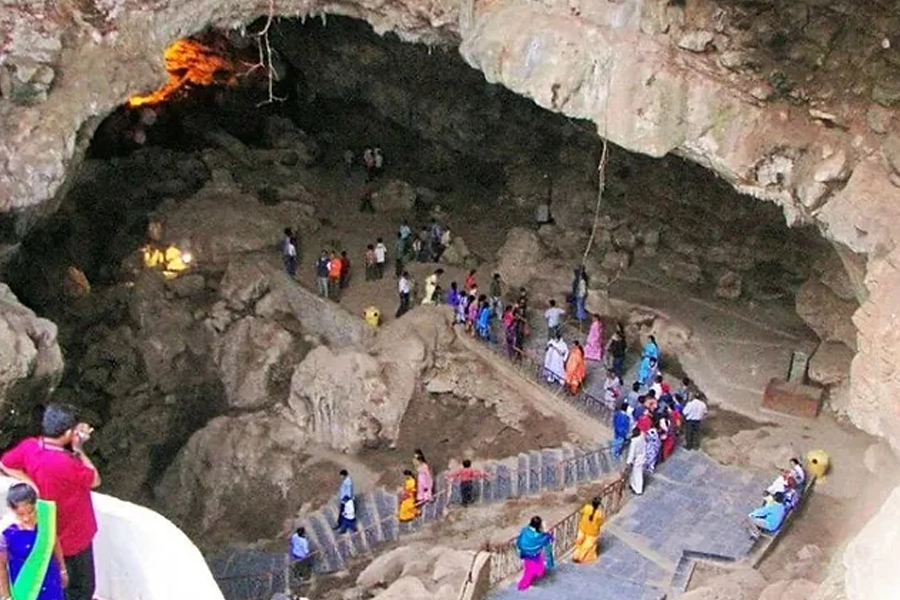
While the famous Patal Bhuvaneshwar cave temple attracts thousands, few know that the entire Jhaltola and Berinag ridge is part of a massive limestone formation. The earth here is hollow, filled with "Sister Caves" that remain unmarked and pristine.
The Geology of the Underworld
These caves are the result of millions of years of water erosion. Rainwater, slightly acidic from absorbing carbon dioxide, seeps through the cracks in the limestone bedrock of the Jhaltola forest. Over eons, it dissolves the rock, carving out massive chambers. When you stand inside one of these hidden caves, you are witnessing an active geological process. The stalactites hanging from the ceiling are not just stones; they are mineral deposits that grow less than an inch every century. It is a slow-motion masterpiece of nature.
The Sacred Silence: Meditation in the Earth's Womb
Beyond the geological wonder, the caves of Upper Kumaon hold a profound spiritual weight. In Himalayan tradition, caves are not just voids; they are spaces of intense energy.
The Sensory Deprivation Experience
When you sit in the heart of a Jhaltola limestone cave and turn off your headlamp, you experience a darkness and silence that is impossible to find on the surface. There is no wind, no birdsong, and no hum of machinery. It is a natural sensory deprivation chamber. For centuries, Sadhus (sages) have used these caves for Tapasya (meditation) because the absolute stillness allows the mind to turn inward. We offer our guests a chance to experience a few minutes of this "Sacred Silence"—a mental reset that feels like a deep slumber for the soul.
Why "Unmarked" is the New Luxury in Travel
In an era where every corner of the world is geo-tagged on Instagram, finding a trail that isn't on Google Maps is the ultimate luxury.
The Psychology of Discovery
When you step onto an unmarked trail in Jhaltola, your senses sharpen. You aren't just following a blue dot on a screen; you are reading the terrain. You look for the way the grass is flattened, the marks on the Oak trees, and the sound of distant streams. At Misty Mountains, we specialize in these "Off-the-Grid" experiences. These trails lead to secret meadows (Bugyals) where the only footprints you’ll find are those of the Barking Deer or the Leopard.
Navigation through Tradition: The Shepherd’s Path
The best "maps" for Upper Kumaon are the ones kept in the memories of the local elders. These paths were carved out over centuries by shepherds moving their flocks to higher pastures.
-
The Ridge Walk: A trail that follows the spine of the Kumaon hills, offering the Nanda Devi range on one side and the rolling valleys on the other.
-
The River Descent: Steep paths that lead down to hidden waterfalls and emerald pools where the water is so pure you can drink it straight from the source.
-
The Ghost Villages: Trails that pass through abandoned stone settlements, offering a hauntingly beautiful glimpse into the history of mountain migration.
Seasonal Shifts: When to Go Beyond the Map
The unmarked trails of Kumaon change their personality with the seasons. Understanding this rhythm is key to a successful expedition.
The Four Faces of Jhaltola
-
Spring (March-April): The "Rhododendron Bloom." The unmarked trails are carpeted in red and pink flowers. This is the best time for birdwatchers to explore the cave entrances where swallows nest.
-
Summer (May-June): The "Cool Retreat." While the plains burn, the deep limestone caves of Jhaltola maintain a constant, cool temperature of around $15$°C to $18$°C.
-
Monsoon (July-September): The "Emerald Mystery." The trails become slippery and challenging, but the waterfalls are at their peak. Caving is restricted during heavy rains for safety.
-
Winter (October-February): The "Crystal Arc." The air is at its clearest, offering the most staggering views of the snow-peaks from our hidden ridges.
The Vertical Challenge: Steep Ridges and Hidden Peaks
Upper Kumaon is not for the faint-hearted. The ridges surrounding Jhaltola offer vertical climbs that challenge your endurance and reward your spirit.
The 360-Degree Reward
One of our favorite unmarked trails leads to a "Hidden Peak" located just outside our 1,000-acre estate. It’s a steep $3$-kilometer scramble through dense Oak forest. But as you break through the canopy at the summit, the reward is unparalleled: a panoramic view of the Panchachuli, Trishul, and Maiktoli peaks without a single tourist in sight. It is a moment of absolute solitude that defines the "Beyond the Map" experience.
The Digital Detox: Why Your Soul Needs to Get Lost
In our hyper-connected lives, we are constantly "navigated." We are told where to turn, where to eat, and what to see. Exploration in the unmarked zones of Upper Kumaon breaks this cycle.
Finding Yourself in the Wild
When the network bars drop to zero and the GPS stops updating, you enter a state of "Flow." On these hidden trails, you find a mental clarity that is impossible to achieve in the city. The silence of the Jhaltola forest buffer acts as a natural noise-canceling headphone for your mind. This "Digital Detox" is why our guests return year after year.
Essential Gear for the Uncharted Terrain
To explore the hidden side of Kumaon, your preparation must be professional.
-
High-Ankle Trekking Boots: The limestone rocks can be sharp and the trails can be slippery.
-
Headlamps with Spare Batteries: Essential for cave exploration where natural light vanishes within $10$ meters.
-
Local Topographic Knowledge: Never venture onto unmarked trails without a naturalist from Misty Mountains.
The Ethics of Exploration: The "Zero Trace" Commitment
As explorers of "Beyond the Map," we have a duty to protect what we discover. The beauty of an unmarked trail is its pristine condition.
Leave Only Footprints
At Misty Mountains Jhaltola, we believe in Sustainable Exploration. We don't mark these trails with paint or plastic ribbons. We teach our guests how to follow natural landmarks—a certain bent tree, a rock formation, or a stream junction. We ensure that our presence in these hidden caves doesn't disturb the bat colonies or damage the delicate mineral formations.
Folklore of the Caves: Where Spirits and Stones Meet
In Kumaoni culture, caves are considered "Dwars" (Gateways) to the underworld or the divine. Local villagers believe that every hidden cave has a "Nag" (Serpent) or a guardian spirit. This folklore has actually helped in conservation; it keeps the caves sacred and prevents people from littering or damaging the fragile limestone formations.
Safety First: The Golden Rules of Himalayan Exploration
Exploration "Beyond the Map" comes with responsibility. At Misty Mountains Jhaltola, we follow a strict safety protocol:
-
The Buddy System: Never explore hidden caves alone. The subterranean environment can be disorienting.
-
Information Logging: Guests must log their expected return time at the reception before hitting unmarked trails.
-
Eco-Ethics: We practice "Pack it in, Pack it out."
Gastronomy for the Explorer: The "Pahadi" Packed Lunch
No expedition is complete without the right fuel. Our kitchen prepares specialized "Explorer Packs":
-
Mandua (Ragi) Rotis: For slow-release energy.
-
Local Ghee and Jaggery: To keep body temperatures stable.
-
Himalayan Spring Water: Sourced directly from our estate's aquifers.
Frequently Asked Questions (FAQs)
Q1: Do I need professional caving experience?
A: No, but you do need a basic level of fitness. Our guides ensure safety for adventurous beginners.
Q2: Are the unmarked trails safe from wildlife?
A: Wildlife is shy. By walking in small groups and with experienced guides, we minimize any risk.
Q3: Can I explore these trails on my own?
A: We strongly advise against solo exploration. The Himalayan terrain is deceptive; what looks like a simple ridge can lead to a steep cliff.
Conclusion: The Frontier Awaits
At the end of the day, "Beyond the Map" is not just about a physical location. It is a state of mind. It is about the curiosity to see what lies over the next ridge and the courage to step away from the crowded tourist circuits.
When you stay at Misty Mountains Jhaltola, you aren't just booking a room; you are securing your place on an expedition. The caves are waiting, the trails are silent, and the map is waiting for you to write your own chapter.
Are you ready to discover the unmarked beauty of Kumaon?